The basics
Call = right to buy at the strike (bullish). Put = right to sell at the strike (bearish).Buyer has the right and pays the premium. Seller has the obligation and collects it.
1 contract = 100 shares → premium $1.20 = $120.

Made for a curious, sharp mind. You'll learn how options actually work, run the numbers like a pro, and see why the people who last are the ones who take risk seriously.


A stock (also called a share) is a tiny slice of ownership in a company. Own one share of a company and you own a teeny piece of it. The share price moves all day as buyers and sellers trade it: more eager buyers push the price up, more eager sellers push it down.
An ETF (exchange-traded fund) is a basket of many stocks packaged into one thing you can buy or sell just like a single stock. Instead of picking one company, you get a little of many at once. That's called diversification: if one company has a bad day, it's only a small part of the basket.
The S&P 500 is an index: a scoreboard that tracks about 500 of the largest U.S. companies (think big tech, banks, stores, energy and healthcare companies). You can't buy an index directly. It's just a number. So people built funds that copy it.
SPY (the SPDR S&P 500 ETF Trust) is the most famous of those funds. It launched in 1993 as the first U.S.-listed ETF, and it holds the stocks in the S&P 500 so that its price follows the index. A handy rule of thumb: SPY's price is roughly 1/10 of the S&P 500 level (not exact, because of fund fees and dividends). SPY is one of the most heavily traded securities on Earth, and options on SPY are some of the most actively traded options anywhere. That's why it makes a great example.
An option is a contract that gives the buyer the right, but not the obligation, to buy or sell something at a locked-in price (the strike) until a certain date (the expiration). The buyer pays for that right. The price paid is called the premium, and it goes to the seller (also called the writer), who takes on the obligation.
CALL = the right to BUY at the strike. Calls get more valuable when the price goes up.
PUT = the right to SELL at the strike. Puts get more valuable when the price goes down.

| Name | What it means | Example (if today is Monday) |
|---|---|---|
| 0DTE | "Zero days to expiration": the option expires today at the close | Buy Monday, expires Monday |
| Daily | SPY has an expiration on every trading day, Mon–Fri | Tuesday's, Wednesday's, Thursday's… |
| Weekly | Expires at the end of the week (usually Friday) | This Friday = 4 DTE |
| Monthly | The classic: the 3rd Friday of the month | Could be 2–4 weeks away |
| Call price | Call is… | Strike | Put is… | Put price |
|---|---|---|---|---|
| $4.67 | ITM | 576 | OTM | $0.67 |
| $3.25 | ITM | 578 | OTM | $1.25 |
| $2.10 | ATM | 580 | ATM | $2.10 |
| $1.25 | OTM | 582 | ITM | $3.25 |
| $0.68 | OTM | 584 | ITM | $4.68 |
| In the money (ITM) | At the money (ATM) | Out of the money (OTM) | |
|---|---|---|---|
| CALL | SPY above strike | SPY ≈ strike | SPY below strike |
| PUT | SPY below strike | SPY ≈ strike | SPY above strike |
Every premium has two parts: Intrinsic value is what it would be worth if it expired right now (how far ITM it is). Extrinsic value (also called time value) is everything else: the extra people pay for the chance it moves further before expiration.
578 call @ $3.25 with SPY at $580 → intrinsic = 580 − 578 = $2.00 · time value = $3.25 − $2.00 = $1.25
OTM options are 100% time value. If SPY never reaches the strike, that time value melts to zero by expiration.
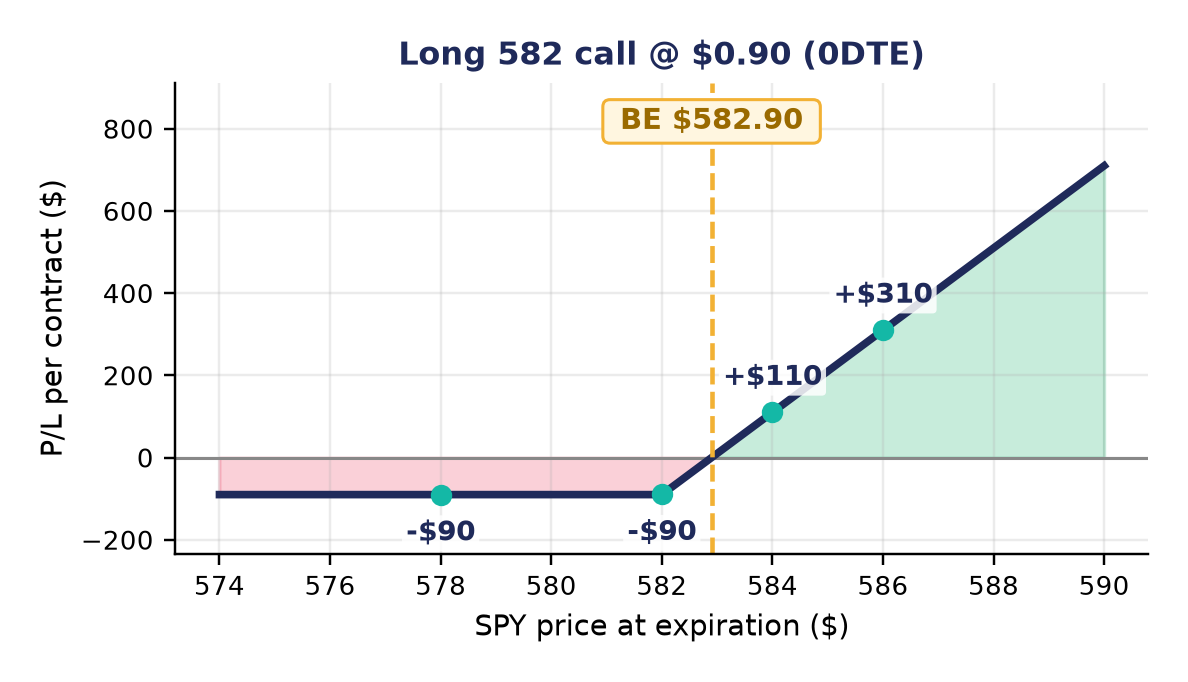
At expiration, an option is worth exactly its intrinsic value. Nothing more, because there's no time left. That makes the end-of-day math clean:
Call value at expiration = max(SPY − strike, 0) Put value = max(strike − SPY, 0)
Call break-even = strike + premium Put break-even = strike − premium Buyer's max loss = premium paid
| SPY close | Value/sh | Contract | Profit / loss |
|---|---|---|---|
| $578.00 | $0.00 | $0 | −$90 (−100%) |
| $580.00 | $0.00 | $0 | −$90 (−100%) |
| $582.00 | $0.00 | $0 | −$90 (−100%) |
| $582.90 | $0.90 | $90 | $0 (break-even) |
| $584.00 | $2.00 | $200 | +$110 (+122%) |
| $586.00 | $4.00 | $400 | +$310 (+344%) |
Delta is about how much the option's price changes when SPY moves $1. A call with delta 0.33 gains about $0.33 (= $33 per contract) if SPY rises $1. Puts have negative delta (they gain when SPY falls). Bonus rule of thumb: delta is roughly the chance the option finishes in the money. A 0.33-delta call has very roughly a 1-in-3 shot.

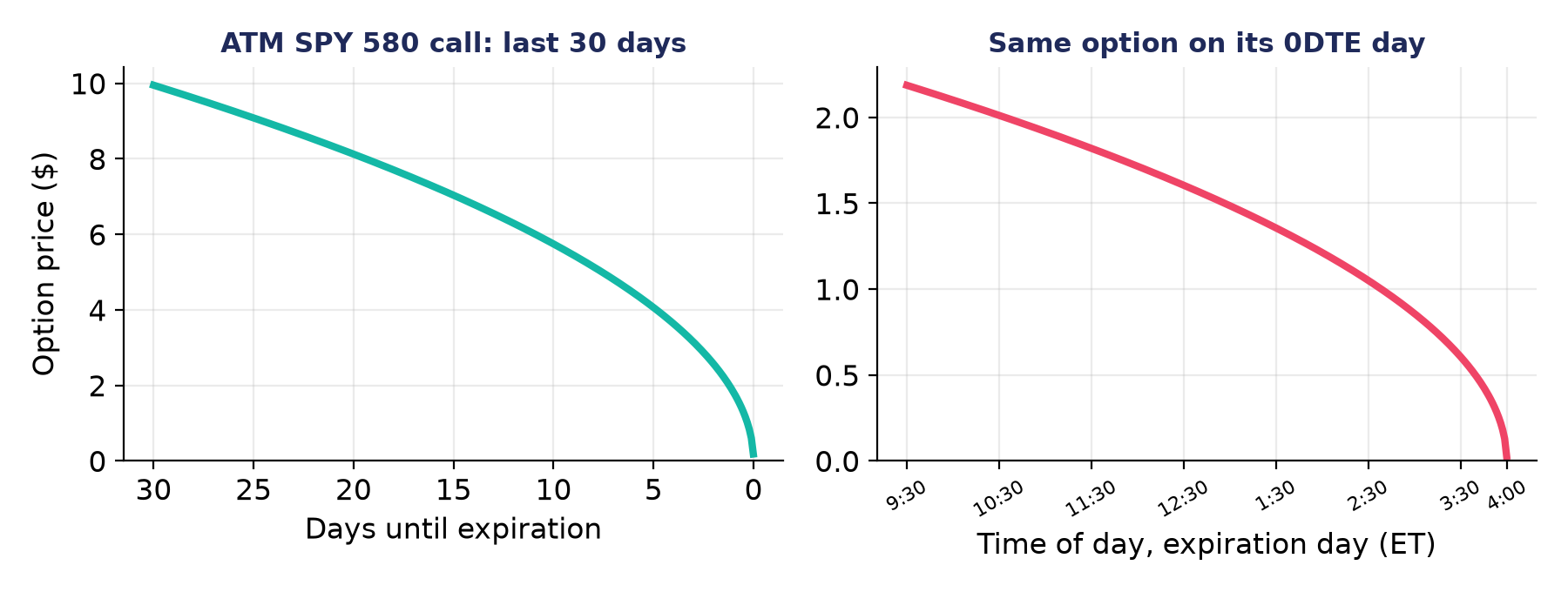
Time value melts every day, even if SPY doesn't move at all. That's time decay, measured by theta. And the melting speeds up as expiration gets closer. A month out, the ice cube is big and melts slowly. In the final days it shrinks fast. On a 0DTE day, it melts by the hour.
Gamma is the accelerator. High gamma means delta jumps quickly as SPY moves. Near-the-money options close to expiration have huge gamma, so they can flip from "almost worthless" to "worth a lot" (and back) in minutes.
Implied volatility (IV) is the market's guess at how much SPY will wiggle. Higher IV → pricier options. Vega measures that effect. The same 0DTE 582 call might cost ~$0.99 at 15% IV but ~$1.56 at 20% IV. After big news (like a Fed announcement), IV often drops fast. That's called IV crush.

Two forces make 0DTE and daily options wild. Leverage: for about $100 you get exposure to 100 shares of SPY (that's ~$58,000 worth), so small moves in SPY turn into big percentage moves in the option. Gamma: close to expiration, delta changes really fast, so the option reacts more and more strongly as SPY moves toward or away from the strike.
| Cost now | If SPY → $582.90 (+0.5%) | If SPY → $577.10 (−0.5%) | |
|---|---|---|---|
| 100 SPY shares | $58,000 | $58,290 (+0.5%) | $57,710 (−0.5%) |
| 30-day 582 call | $9.00 ($900) | ≈$10.45 (+16%) | ≈$7.68 (−15%) |
| 0DTE 582 call | $1.00 ($100) | ≈$2.31 (+131%) | ≈$0.33 (−67%) |
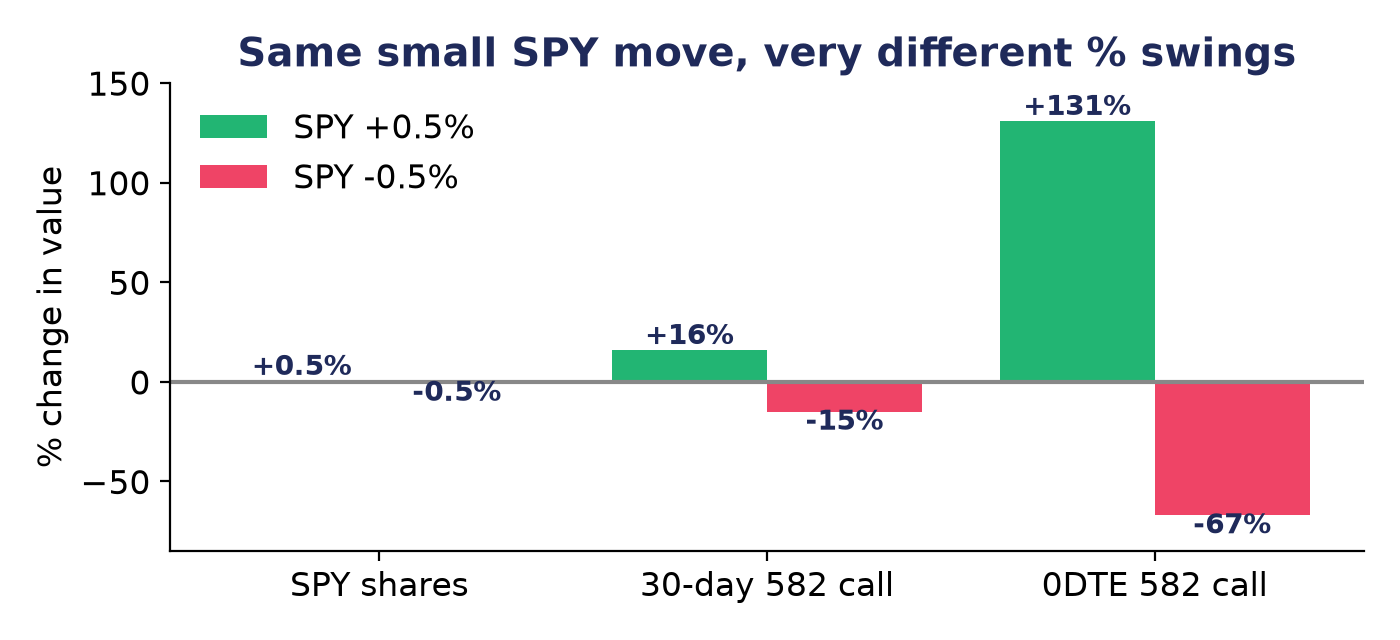 Gamma in action: after that $2.90 rise, the 0DTE call's delta jumps from about 0.33 → 0.58. The 30-day call's delta only goes 0.48 → 0.52. And if SPY just sits at $580 until 4:00 PM? The 0DTE 582 call goes to $0 (−100%), while the 30-day call barely notices.
A spread means buying one option and selling another on the same stock and expiration but at different strikes. Selling the second option lowers your cost, but it also caps your profit. The win: your max loss and max gain are known before you start.
Debit spread: max loss = net debit max gain = strike width − debit
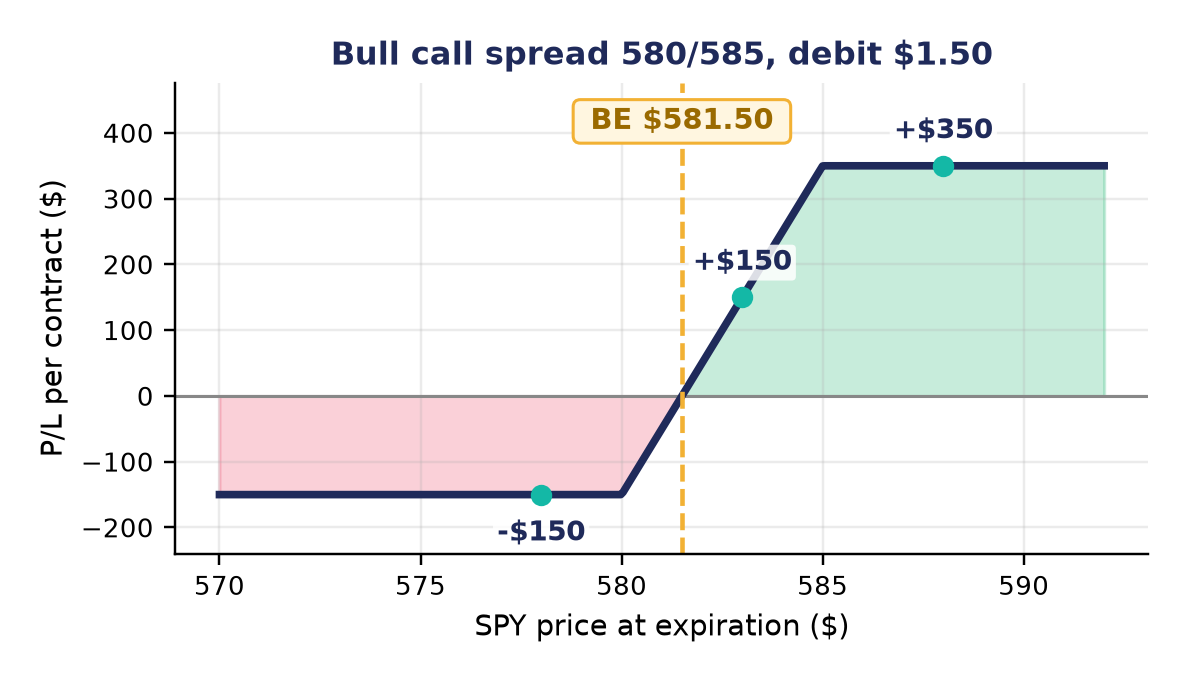
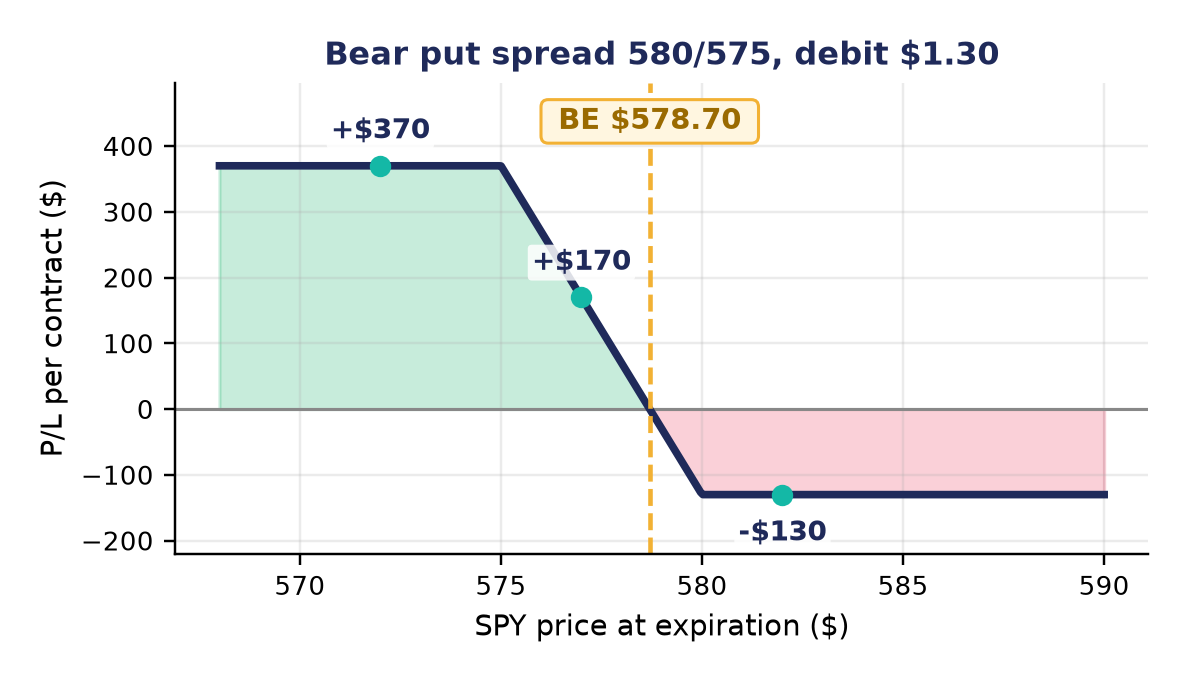
| SPY at Friday close | $576 | $578 | $580 | $581.50 | $583 | $585 | $590 |
|---|---|---|---|---|---|---|---|
| Bull call spread P/L | −$150 | −$150 | −$150 | $0 | +$150 | +$350 | +$350 |
| Bear put spread P/L | +$270 | +$70 | −$130 | −$130 | −$130 | −$130 | −$130 |
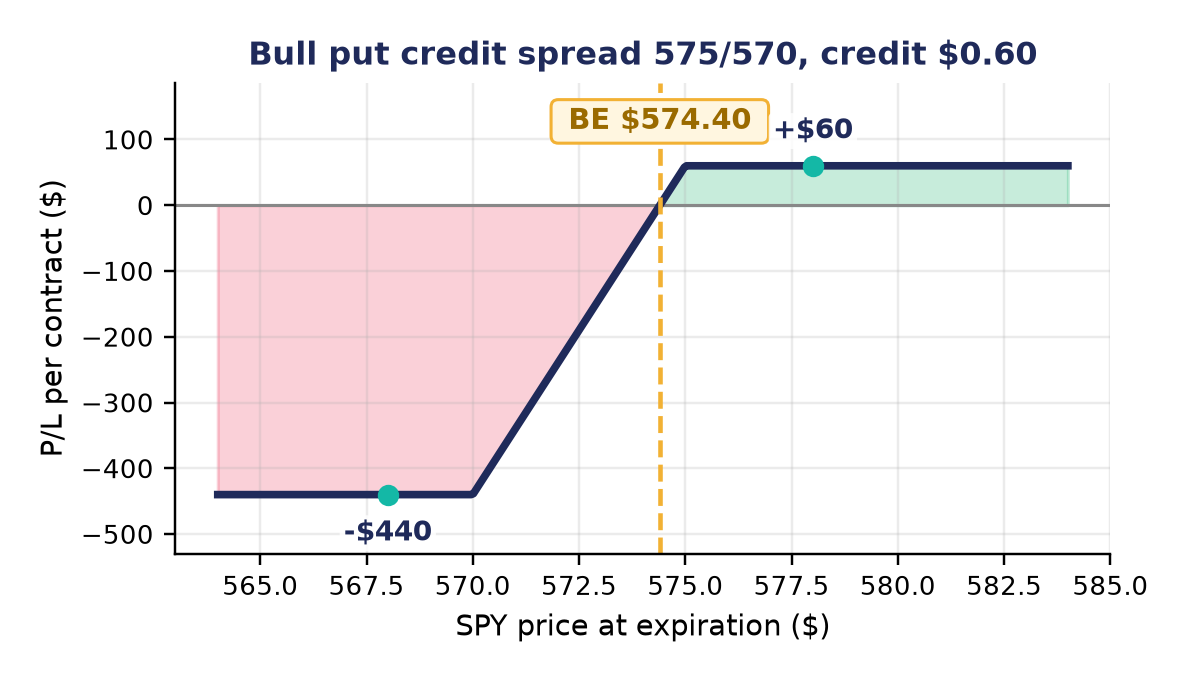


Tip: write your plan before you click. If you can't fill in the "max loss" and "exit plan" boxes, you're not ready for that trade.
| Week | Mission | Badge to earn |
|---|---|---|
| 1 · Observer | No trades. Each day, record SPY's open and close and make a guess (up/down) before the open. Pick the 0DTE ATM call and write its price at 10:00, 12:00, 2:00 and 3:30. Watch the ice cube melt! | 🧊 Time-Decay Detective |
| 2 · Careful Buyer | Max 1 paper trade per day, 1 contract, using weekly (not 0DTE) options. Before each trade, write the break-even and max loss. | 📝 Plan-Before-Click |
| 3 · Spread Builder | Paper-trade bull call and bear put spreads. Calculate max gain, max loss and break-even first, then check whether the result matched your math. | 🧮 Spread Mathematician |
| 4 · 0DTE Lab | One tiny 0DTE paper trade per day (within the 1–2% rule). Use a time stop: close it by 3:00 PM no matter what. Note how fast it moved (gamma!). | ⏱️ Gamma Tamer |
| Date | Option(s) & expiration | Why? (my idea) | Cost | Max loss | Break-even | Exit plan | Result | Lesson learned |
|---|---|---|---|---|---|---|---|---|
| Mon | Buy 1 SPY 585C @ $1.50, Fri exp. | Bounce off $578 | $150 | $150 | $586.50 | Sell at +50% or Thu 3 PM | −$60 | Theta ate it while I waited |
| Action | Points | Action | Points |
|---|---|---|---|
| Wrote the plan before entering | +3 | Calculated break-even correctly | +2 |
| Stayed within the 1–2% risk rule | +3 | Followed the exit plan (win or lose) | +3 |
| Wrote a "lesson learned" | +1 | Revenge trade / broke a rule | −5 |
| ITM | ATM | OTM | |
|---|---|---|---|
| Call | 575 | 580 | 585 |
| Put | 585 | 580 | 575 |
Educational material only. Not financial or investment advice. All prices are illustrative examples (some estimated with a Black-Scholes model at 15% implied volatility, no interest or dividends), not real quotes. Options involve substantial risk and are not suitable for all investors. Before real trading, an adult should read the OCC's Characteristics and Risks of Standardized Options. Illustrations of the original character "Nova Amari" were AI-generated for this guide.